Tyranny: Where Did It Begin?

We often attribute the loss of freedoms to singular events or individuals, be it policies of recent leaders or external crises like the pandemic. Yet, this linear thinking ignores the broader systemic and historical forces at play.

Some claim the loss of our freedoms began with Obama. Others point to the rise of impolite discourse under Trump or blame COVID for sparking inflation. But these explanations, though appealing in their simplicity, fail to grasp the interconnectedness of events and the accumulation of forces over time.

In reality, identifying a single starting point for societal decline often leads to an infinite dive into the rabbit hole of:

No appropriate solution found!

The truth is, by the time a problem is noticed or an inflection point becomes clear, it is often too late. Events, like physical objects, possess mass and momentum. The mass represents the burden of history, while momentum reflects the pressures of the current environment, propelling events toward outcomes that seem inevitable only in hindsight.


The Tyranny of Power

Today, a friend remarked that the United States is the most tyrannical government in the world. While the statement seemed exaggerated, it provoked reflection. Tyranny, as defined by the Oxford Dictionary, is “the cruel, unreasonable, or arbitrary use of power or control.” By this measure, there is evidence to consider.

Governments throughout history, including democracies, have concentrated power in ways that could be deemed tyrannical. But why does this happen? The answer lies in the recurring emergence of a small but significant segment of society: psychopaths.

Societies have always produced a percentage of individuals with psychopathic traits—those who excel at manipulation, thrive in competitive environments, and are driven by ambition unchecked by empathy. These individuals frequently rise to positions of power at all levels, from families to global institutions. Their control, however, is not inevitable. Resistance is possible but depends on the collective alignment of the majority under a shared set of principles. These principles act as the defense against the abuse of power.


The Declaration of Independence: A Radical Act of Resistance

The history of human civilization is a history of resistance against oppression, and few moments exemplify this better than the founding of the United States. The Declaration of Independence was not merely a document; it was a revolutionary statement—a bold assertion of the right to self-rule, free from tyranny. Its preamble famously declared:

“We hold these truths to be self-evident, that all men are created equal, that they are endowed by their Creator with certain unalienable Rights, that among these are Life, Liberty and the pursuit of Happiness.”

But this declaration was far more than a plea for freedom from the British Crown. It was a direct challenge to entrenched global systems of power. The authors of the Declaration understood that they were waging war, not only against Britain, but against a global cabal of political and financial elites whose influence extended far beyond the monarchy.


Who Was Threatened by American Independence and Why?

The Declaration of Independence was a seismic shift that threatened not just the British Empire, but the broader global order built on oppression, exploitation, and concentrated power. At its core, this new constitutional republic challenged a system where atrocities were the norm, and the architects of these systems often exhibited the traits of psychopaths: lack of empathy, a singular focus on control, and ruthless execution of their plans. Here’s how some of the most powerful entities at the time perpetrated atrocities that required such leadership:


1. The British Crown and Aristocracy

The British monarchy and aristocracy depended on a brutal system of colonial extraction to sustain their wealth and power. This system was built on atrocities, such as:

  • Taxation and Starvation: The forced extraction of wealth through taxation left colonies in financial ruin while enriching aristocrats. Famines in British-controlled territories, like Ireland and India, were exacerbated by policies that prioritized exporting resources for imperial profit, even at the cost of millions of lives.
  • Indentured Servitude: The colonies were a dumping ground for Britain’s “undesirable” populations—debtors, prisoners, and the poor—who were shipped across the Atlantic to work under inhumane conditions.

Such policies required leaders who could suppress dissent, enforce cruelty without hesitation, and dismiss the suffering of millions. Only individuals willing to subordinate morality to ambition could rise and maintain power in such a system.

When the American colonies declared independence, they not only threatened the Crown’s wealth but also exposed the inherent inhumanity of this system, inspiring others to resist.


2. The British East India Company

This corporation, often described as a government unto itself, represented the zenith of psychopathic exploitation in pursuit of profit. The company perpetrated some of history’s most egregious atrocities, including:

  • The Bengal Famine (1770): Caused by exploitative taxation and forced cultivation of cash crops like indigo and opium, the famine killed an estimated ten million people. Company officials prioritized profit over human life, stockpiling resources while people starved.
  • Drug Trafficking: The company was a key player in the global opium trade, forcing China into addiction and precipitating the Opium Wars. Millions suffered as the company used military force to maintain its profits.

These atrocities were no accident; they were the result of deliberate policies crafted and executed by individuals who saw people not as humans, but as resources to be exploited. The success of a constitutional republic like the United States, free from monopolistic corporate control, threatened to unravel the company’s grip on global trade and undermine the economic model it depended on.


3. European Monarchies and Empires

The monarchies of France, Spain, and other European powers relied on systemic violence to maintain control over their colonies and their populations. Atrocities included:

  • The Encomienda System: In Spain’s colonies, indigenous peoples were enslaved and worked to death in mines and plantations under the guise of “Christianizing” them. The system decimated native populations, with some estimates suggesting a ninety percent decline in the population of the Americas following European conquest.
  • Suppression of Uprisings: From the Dutch revolt in the Spanish Netherlands to the brutal crushing of peasant uprisings across Europe, monarchies displayed zero tolerance for resistance. Torture, mass executions, and scorched-earth policies were common.

To sustain such systems, monarchs and their advisors needed to embrace or overlook extreme cruelty. A constitutional republic founded on the principles of equality and individual rights was an existential threat, as it directly undermined the divine right of kings and the hierarchy they imposed. Worse, it might inspire their own populations to rise up.


4. Banking and Financial Interests

The financial systems of the British Empire, as well as other European powers, thrived on exploitation and war. Banks and financiers played a pivotal role in perpetuating atrocities by funding and profiting from systems of oppression. Examples include:

  • Financing Slave Trade: Major banks provided the capital needed to build and maintain the transatlantic slave trade. This “industry” enslaved millions of Africans, subjected them to inhumane conditions, and caused generations of trauma.
  • War Profiteering: Wars were seen as opportunities for profit, with financiers funding both sides of conflicts to maximize returns. The Napoleonic Wars, for instance, saw banks like the House of Rothschild amass immense wealth while millions died.

Psychopathic tendencies flourished in these environments. Bankers and financiers prioritized profit over human life, manipulating governments and economies to ensure their control. The American Revolution disrupted these systems, as a republic with decentralized governance and resistance to taxation without representation undermined the financial order they depended on.


The Role of Psychopathic Leadership in Atrocities

Psychopaths rise to the top in such systems because their traits—calculated decision-making, lack of remorse, and relentless ambition—make them uniquely suited to perpetrate and sustain large-scale atrocities. These leaders:

  1. Dehumanize Populations: To exploit or destroy others, they must view them as expendable. This dehumanization was evident in colonial policies, the slave trade, and the global drug trade.
  2. Suppress Opposition Ruthlessly: Maintaining control required silencing dissent through violence and intimidation, as seen in countless rebellions and revolts.
  3. Pursue Power Without Constraint: Whether as monarchs, corporate leaders, or bankers, they pursued power relentlessly, prioritizing it above all else.

The success of the American Revolution was not just a threat to these entities’ wealth or power; it was a direct challenge to the psychopathy that enabled them to commit such atrocities. A government founded on principles of equality and individual rights demanded a fundamentally different kind of leadership—one based on empathy, justice, and accountability.


A Fight Against the Old Order

The Declaration of Independence was a profound challenge to the status quo. Its principles of self-rule and individual rights struck at the heart of a world order built on exploitation and concentrated power. Yet, even as it sought to dismantle the oppressive structures of monarchy and empire, the founding vision did not fully account for a deeper and more insidious force: the tendency of systems, regardless of their design, to be subverted by individuals with psychopathic tendencies.

Psychopaths—those who lack empathy, thrive on manipulation, and are driven by an insatiable desire for control—are not bound by ideology, morality, or law. They excel in climbing to positions of power in any system, whether a monarchy, a financial empire, or even a constitutional republic. The very traits that make them dangerous also make them formidable within political, economic, and social hierarchies. Over time, their ability to exploit rules, manipulate others, and consolidate power often transforms the very systems meant to protect the people into tools of oppression.

The reaction to the Declaration of Independence was immediate and brutal. Monarchies, financial institutions, and empires recognized the revolutionary ideas as existential threats. But what truly fueled their suppression was not just the preservation of wealth or authority—it was the survival of a hierarchical system that psychopaths had long dominated. These systems, built on exploitation and control, were perfectly suited for individuals who thrived on subjugation and the ruthless accumulation of power.


The Unyielding Rise of Psychopathy

History reveals a stark truth: no political structure—whether monarchy, democracy, or republic—is inherently immune to the rise of psychopaths. Left unchecked, these individuals inevitably infiltrate and corrupt even the most well-intentioned systems.

  • Monarchies allowed psychopaths to wield power through divine right, suppressing dissent with violence and fear.
  • Financial empires enabled psychopaths to exploit entire populations for profit, prioritizing wealth over human lives.
  • Republics—despite their emphasis on equality and individual rights—are not exempt. The ability to manipulate public opinion, exploit legal loopholes, and co-opt democratic processes offers psychopaths new avenues to subvert power.

In every case, their rise is facilitated by the same factors: a lack of systemic safeguards to identify and suppress psychopathic behavior, and the failure of societies to recognize their influence before it is too late.


A Republic’s True Challenge: Identifying and Suppressing Psychopathy

The American Revolution was a triumph of principle, but its enduring success depends on addressing a fundamental flaw: the system’s vulnerability to manipulation by those with psychopathic traits. Any republic that wishes to stand the test of time must not only protect the rights of its citizens but also guard against the rise of individuals who would exploit those rights for personal gain.

This requires a radical shift in focus. Instead of merely crafting laws or policies to address the symptoms of systemic failure, a republic must actively work to:

  1. Identify Psychopathy in Leadership: Develop psychological and behavioral criteria to recognize individuals who demonstrate manipulative, callous, and antisocial traits in positions of power. Tools such as psychometric assessments, rigorous vetting processes, and public transparency can help prevent psychopaths from gaining influence.
  2. Design Systems to Resist Exploitation: Political structures should be adaptive and resilient, with mechanisms to decentralize power, limit corruption, and ensure accountability. Checks and balances, while essential, must evolve to address the subtleties of modern manipulation.
  3. Educate Citizens to Recognize Manipulation: A well-informed populace is the best defense against psychopathic leadership. Education systems should prioritize critical thinking, media literacy, and an understanding of history’s lessons about the rise of tyrants and manipulators.
  4. Suppress Psychopathy in Governance: Once identified, individuals exhibiting psychopathic behavior should be removed from positions of influence. This requires courage, transparency, and a commitment to principles over personal or partisan loyalties.

Conclusion: What Can We Learn?

The struggle for freedom is not a relic of the past—it is an ongoing battle against the ever-present threat of concentrated power and manipulation. The forces that opposed the American Revolution have not disappeared; they have simply evolved, taking new forms in corporate monopolies, authoritarian governments, and unchecked financial systems. At the core of these threats lies the same dynamic: the rise of individuals who use power for personal gain, indifferent to the harm they inflict on others.

The lesson of history is clear: no system is immune to corruption. If a republic wishes to endure, it must focus not just on its foundational principles but also on the human weaknesses that threaten those principles. Identifying and suppressing psychopathy must become a central focus of governance—a safeguard against the subversion of liberty.

The question is not whether such vigilance is necessary but whether we, as a society, have the will to implement it. Will we align under principles strong enough to resist, as the founders once did? Or will we allow history to repeat itself, with systems once designed to protect us becoming tools of oppression? The answer lies in our ability to recognize and address the root causes of tyranny, starting with those who embody it.

The Slight Edge

I am reading The Slight Edge by Jeff Olson. The read is wonderful and more importantly it is about a subject so basic that we often lose track of it, do the good things everyday. Life is not about winning the lottery but about the good things everyday. This is how you should vote, not for the big wins, but for the good things everyday.

Roles: They are important

hammer

My hammer has a role.  I use it to hammer nails into wood and take them out.  I could use it as a lever to pull a sheet of wood off a wall, but I don’t.  I don’t because sometimes this ruins the handle.  Instead, I use my crowbar.  My knife has a role.  I use it to cut rope, paper, tape on boxes, and straight lines into wood.  I’ve seen knives used as screw drivers but after they are used that way they don’t cut a straight line into wood.  When I think about my tools, I don’t think my hammer is better than my knife.  I think it is important to have them both to be successful at what is being accomplished.

People are like tools.  We all have things we are good at, and sometimes, if we are lucky, better at than anyone else.  Just like there are a lot of different hammers there are a lot of different men.  Just like there are a lot of different knives there are a lot of different women.  Men and women are not the same.  They look similar and they work together well, but they are not the same.  A hammer is not a knife and a man is not a woman.  They are different.  Just like I can use a knife as a screw driver, a man can nurture and rear a child.  Just like a hammer, a woman can be an effective instrument in war.  Personally, I prefer that children have soft gentle kindness as an example of how to treat people in their lives as a primary influence from their role models.  I also want my children to develop that hard survival core that allows them to survive in all situations by removing themselves emotionally and executing practically.  However, I prefer this influence to take up less of their time.  As a man, I recognize that the survival imperative promoted by testosterone is useful but not always desirable, just as the social imperative promoted by estrogen is essential but not always practical.  I do not place a moral construct around this.  If anything, I recognize it as a universal truth, that all animals and plants strive to survive in an environment where resources are limited.

When men are demonized for being who they are, not the assholes that abuse others, but the ones that are inept but still clumsily trying, we are moralizing the hammer.  Men want to be loved, be admired, and propagate.  Some may not be good at the competition, lacking knowledge of how to ask or to approach women for what they may both desire.  If they are clumsy, are they an atrocity?  Is there really a moral value being placed on asking?  Have we come to a place in history where we refuse to use the hammer because of the moral implication of the blunt nature of the tool that makes it effective?

There are many men and women who are assholes.  They promote themselves at the expense of others.  They use inordinate power to take what they can get.  They make villains of an entire category of humanity for not dancing correctly to the music they are playing.  The vast majority of all us are inept at the sophisticated protocols required to broach a need.  We lack the sophistication to overcome the barriers to entry in order to meet our need for solace, love, kindness, a relationship, and yes sex and the need to propagate.

The rules of engagement between men and women are a slippery slope with vast implications.  If you write the rule book without agreement from both participating sides, then you can expect discord.  Men must be able to approach, to try, and women must be able to deny or accept without resentment for the attempt or condemnation for making her own decision.

Man bashing is ridiculous.  Deifying women is ridiculous.  We are all humans, like the hammer and the knife, useful tools in the belt of mankind, equal in our value.

Male silence after #MeToo is teaching algorithms what being a man means


AI Language Translation and Programming

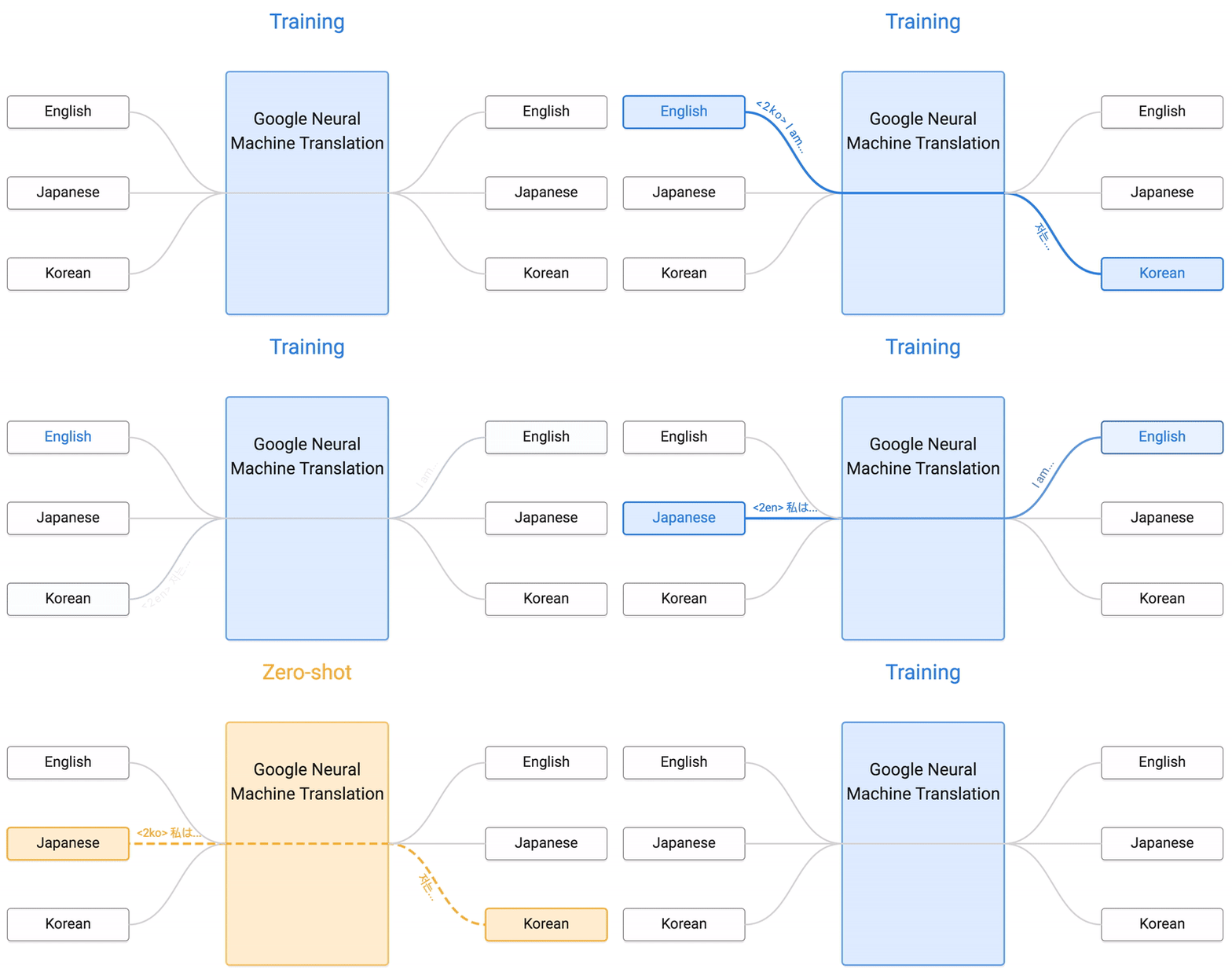
I am sure that what I am about to discuss is not original.  Writing this is based on my eternal frustration with programming in so many languages over the years that it amazes me something has not been done about it.  Now, I imagine, it is being done, just not out in the open.  Let’s start with a simple image of the Google Translation Engine.

So, what is the big idea?  Seems to me this same mechanism can be used to translate any programming language into another almost instantly.  Now, wouldn’t that be great?


Allow Our Heroes to Rise

trumpswearingin

I graduated in economics 45 years ago.  In those days we were taught that humans were rational and made rational decisions based ultimately on utility, the exchange value of what they received for what they delivered.  Forty-five years has taught us a thing or two about psychology and how the mind works.  We now know that humans are far from rational and the Theory of Utility has been replaced by the Theory of Propensity.  We often exchange more value for less value irrationally.  In fact we act irrationally about many decisions, so much so that the vast majority of our decisions are knee jerk decisions caused by racing neural impulses following well worn tracks in our brain.  Today, one day after the inauguration of Donald Trump, I can’t help wonder, “How can so many believe they know the future having done so poorly predicting it in the past?”

kicklikeagirl

Years ago after having taught Karate for over 15 years, coached soccer and basketball for over 10, hired and fired in business for 20, I came to some realizations about judging people and their performance, “The impossible will happen.  Some you never expect will rise.  Some you believe are indomitable will sink.”  The key to good coaching is to be patient, train to incentivize dedication, respectful communication, discipline, and objectivity.  Above all things you do as a coach you give everyone an equal opportunity to shine and be a victor over the obstacles to their success.

carmencitta-you-either-die-a-hero-or-live-long-enough-to-see-yourself-become-the-villian

We live in a country dominated by a media where the heroes and villains are decided by the clothes they wear, by the tribe they belong to, by the cadence of their speech, by the money in their pocket, by what they have said over the history of their lives. Our media immortalizes the down trodden and makes villains of the successful.  The employees in the media corporations around the world have become the prognosticators of value.  They tell us who is good and who is bad without objectively balancing the equation.  In their delusional attempts to demonstrate  objectivity they fail the acid test of reproducibility.  Subjective claims of moral values often times disregard the long term cause and effect that may result.  In our wild claims of human atrocity in Iraq America dismantled their physical and political infrastructure causing the murder of millions and creating a political vacuum that may not right itself for a thousand years.

sully-passengers-flight-1549

It is a sad day when you don’t let the person who has done everything they can, sacrificing time, money and respect to prove themselves a champion of the people.  Perhaps we are delusional believing the presidency is an wonderful office to hold with prestige and pomp.  In fact, it is the hardest job on earth, and any champion who rises to wield the sword of prosperity should be given a chance to wield it for the hope and future of our nation.  They may rise, they may sink.  Our history is replete with both.  Since none of us know the future, or can predict it based on words, skin color, or age, we must let our victors rise on the field of value, gauging not by our dislike of their personality but by the temper of their spirit and value delivered over time.  We do not enter this fight afraid.  We enter this fight aware.  If we predict our teammates failure, they surely will.  Let us all place the might of our collective desire for a better America and better world behind Trump’s back and push predicting victory.


Ebola – Politics as Usual and the Doom of Mankind (Part 8)

John Kerry chastised organizations worldwide for not throwing enough money at Ebola apparently believing that we will fall for the old leader who follows the news and asks for money story. Leaders mobilize without money.  They take action that does not cost a dime.  They shut down borders,  shut down air traffic,  and create processes that ensure safety. 

Our questionable leaders ask for more money in times of crisis and are proud they shook the hand of the known victim of a contagion.  Perhaps they are not leaders at all. 

Ebola – The Tragic Comedy of Prescience (Part 7)

“The CDC is asking all 132 passengers on Frontier Airlines flight 1143 from Cleveland to Dallas/Fort Worth on October 13 to call 1 800-CDC-INFO (1 800-232-4636). The CDC says the risk of infection is low, but that the agency still wants to interview all of the passengers.” – Healthline News, Written by Sandra Levy | Published on October 15, 2014

THE CDC MESSAGE
“Hey listen, there is almost no chance of you getting Ebola or infecting someone else, we say that because it has never happened before, well, except in one instance just prior to this, but if you have a couple of minutes, you know, you’re not do anything, and you want to chat, why not call us at the CDC?”

MY ACTION
I have assigned 132 people the task of tracking down and isolating 132 passengers from the Frontier Airlines flight 1143 from Cleveland to Dallas/Fort Worth on October 13.  All 132 people tracking down the passengers and the passengers themselves will be isolated in separate locations purchased by us in the town they are located in.  All people they have come in contact with will be tracked down and isolated as well.  There will be no physical contact with these individuals from the outside world for 21 days except using technological communication.  We will compensate all parties financially and provide facilities so that all involved individuals can carry on their work remotely if possible.  Each physical location will be guarded around the clock.  Every effort will be made to make the facilities pleasant to live in and not a prison.

The reaction of those involved in securing our future and protecting us is abhorrent.  Demand better.

Ebola – Weep Tears Now for Your Culture Lost (Part 6)

Weep Tears Now for Your Culture Lost

Shed your tears now
Cry for the clean water you drink
Cry for the light at night
Cry for the safety in our streets
Cry for the roads you drive on
Cry for the family alive that you love
Cry for the friends you cherish
Cry for the society you have shared

Soon, too soon, all your tears will be shed
Your water will be soiled
Your light will be gone
Your safety will be lost
Your roads will be shattered
Your family will be smaller
Your friends will expire
Your society will not endure

Perhaps we can still save ourselves.  To do so we must elect new leaders who understand prioritization, who are not the puppets of power, but leaders through prescience and compassion.  We need leaders who are not the victors of the downtrodden, but the heroes of our future.  Men and women who look past what other’s want to hear to what we cannot afford to hear.  We cannot afford to hear that Ebola is airborne.  We cannot afford to hear that borders are open.  We cannot afford to hear that our healthcare system, weakened and riddled by the prosperity of assured payments and specialized medicine is prepared and capable of handling Ebola.  Our healthcare system is woefully inadequate.  Is our healthcare system in your home?  Is it at your work place?  Is it sitting on the park bench?  Are their members brothers and sisters of the massive homeless population, the auger of Ebola.  Who will protect us from those who don’t know, don’t care, and won’t act?

We have one hope and one hope only, that you, the populace recognizes the danger and acts accordingly.

I, who do not believe in God, pray that you do.

Ebola – Should Have Kept Those Damn Gloves On(Part 5)

Mass Murderer?

Mass Murderer?

Perhaps, if we all survive the many threats to our modern survival as a species, we will eventually have predictive models that use the momentum of words written all over the world to somewhat know the future and act accordingly.  Until then, we are left with the wise words of any great combatant that ever lived,”Always overestimate your opponent.”

Before going any further in this article, I want to personally note that Thomas Eric Duncan could turn out to be the most horrible man in the history of the world through total neglect of his potential impact on humanity.  If Ebola breaks out in the United States and is unchecked for many months there could be global economic disaster.  He was unwilling to sacrifice his investment in an airline ticket to see his relatives in Texas while being willing to spread what he had seen first hand as the worst virus we have faced since the dark ages.

How do we sift through the mountains of information and come to some conclusion that allows us as a population to act appropriately?  First, we have acted too late, sitting in the twin towers because others were sitting in the twin towers, unwilling to raise the alarm.  We start by overestimating our opponent, Ebola.

“The virus behind this outbreak made the jump to humans late last year, in Guinea. The key event in the spread to Sierra Leone was the funeral of a faith healer who claimed to be able to cure Ebola patients. When she contracted Ebola and died in late May, a large number of people attended her funeral.

Twelve of the first Ebola cases in Sierra Leone all attended that funeral, and appear to have contracted the virus there. These include two distinct forms of the virus which diverged, in Guinea, in late April.” – Rob Brooks (2 September 2014, 3.21am BST)

How does one go about overestimating an opponent?  We start by analyzing their strengths and our weaknesses.

Ebola’s four greatest strengths are:

  1. It can appear like any other virus in the beginning with aches and a runny nose
  2. It has a 7 to 21 day gestation period
  3. It is a new strain of Ebola, mutating rapidly, in a highly diverse DNA portfolio
  4. It is lethal in at least 40% of all cases

Our greatest weaknesses are:

  1. Arrogance
  2. Less than timely action
  3. Fear of loss based reactions, i.e. loss of money, loss of power, loss of credibility
  4. Protocol based behavior, i.e. we do what we have always done

How to mitigate the strengths of our opponent?

It can appear like any other virus in the beginning with aches and a runny nose

The result of this will be many false positives, people believing they have Ebola when they do not.  The consequence of this in conjunction with our protocol based behavior is that we will flock to Hospitals, ERs, and Day Clinics and sit in rooms waiting to be told if we have Ebola.  Some of the people in the room will have Ebola setting up a quarantine situation that is untenable.  Where will we house all these people in quarantine?

We should set up community clinics outside in wide open spaces with tables spread far apart with medical personnel dressed appropriately to avoid both airborne and fluid contact.  If chairs are used for the waiting patients they should be set very far apart and signs should be posted asking them to avoid contact with others.  If there are ketones specific to patients with Ebola sensors should be manufactured that can provide a first data check on whether to test blood samples.  The new blood test system that Elizabeth Holmes invented should be used in all cases to avoid transport and possible testing issues.

It has a 7 to 21 day gestation period

Because the greatest risk to our communities is based on rapid transportation’s ability to move the virus throughout the country in days rather than years it is important to quarantine cities after a very small number of infected individuals have been found in a city.  This means no travel out of the city for 21 days after identification has occurred.

It is a new strain of Ebola, mutating rapidly, in a highly diverse DNA portfolio 

We must assume the the virus can become airborne whether it currently is or not.  All of us acting with a respect for personal space and making sure neither our air, spit, or body liquids touch others is a good policy during this time.  Advising that the virus is not airborne is a huge mistake.

It is lethal in at least 40% of all cases

A 40% death rate is very conservative.  In fact, it has attained a 90% death rate when conditions favor the virus.  What are those conditions?

  1. Religious ceremonies conducted taking a priority over safety
  2. The cleanliness of the environment
  3. The respect given to the potential of infecting others

How do we address our weaknesses? 

Before you believe you have this fight won, prepare for the fight and believe it is lost unless you have your best fight ever.  If you think you have Ebola, immediately get checked and avoid contact with others.  Act immediately as an individual, as a community, as a nation to be safe.  Fear of the loss of our culture should take precedence over money, time, and power.  Be safe.

Ebola – The Gloves are Off (Part 4)

It has been 45 days since I last wrote on Ebola.  We who write understand that for most of us our voices are mere bubbles in the vast river of conversation that flows around our planet.  We hope, if our analysis is correct, that others with more influence communicate a similar message.

Here is a chart of the number of searches, equatable to global interest, for ebola in the last three months.

Last three months of global searches for ebola

Last three months of global searches for ebola

This chart is screaming, “Interest in Ebola is dying out just when the contagion is getting it’s stride.”  Ebola is, for us, an event of interest like the war on ISIS.  It does not, right now, immediately effect us.  We are immune to the disasters that plague Africa.  Ebola is not a local War or even a well funded war that effects the global price of oil.  It is a contagion without an effective counter measure.  The only counter measure we have found in the past to be effective, isolation of the contaminated, is failing us.

It is well known that we as a species underestimate the future potential of a true disaster and overestimate our ability to deal with it. 

I applaud the media for elevating the true potential of the disaster that awaits mankind if we are not effective in our war against Ebola, right now.   The medias efforts are waning.  This is the second egregious mistake with respect to this outbreak of Ebola we as a civilization have made.  The first egregious mistake was underestimating the potential impact of Ebola on the world’s population and consequently not shutting down all traffic in and out of areas with the contagion.  The second egregious mistake is not utilizing global media to elevate awareness and as such reaction to the contagion.

Here is the trend data from google for hot searches in the last two days.

Sunday, September 21, 2014

  1.  Rob Bironas

Saturday, September 20, 2014

  1. Jameis Winston
  2. Gabrielle Union
  3. The Fappening
  4. Polly Bergen
  5. Alabama Football
  6. Mr Olympia 2014

An analogy for the search behavior on the internet reflecting global interest and concern is:

A man is walking across the street with a friend reading a People magazine.  He looks up to see a semi-tractor coming in their direction start to skid out of control two blocks away,  points at the incident, and tells his friend.  His friend looks up from reading, calculates that he will be across the intersection before the truck arrives, and goes back to reading.  The truck explodes into a fireball and continues towards the two men as they near the other side of the street.  The fellow reading People continues to read.  The People magazine reader failed to determine the speed, the momentum, and the possible chain reaction possible from the oncoming semi going out of control.  Those miscalculations will cost him his life.

To repeat the obvious.  No person should be allowed out of any country that has people infected with Ebola.  No exceptions till the contagion is checked.  Not to employ this recipe is to continue to read People magazine as our certain death approaches.